
Magellan
Venus Radar Mapping and Hidden Surface Detail
Magellan is a mission story that lets users explore Magellan, the mission that used radar to map Venus beneath its thick cloud cover.
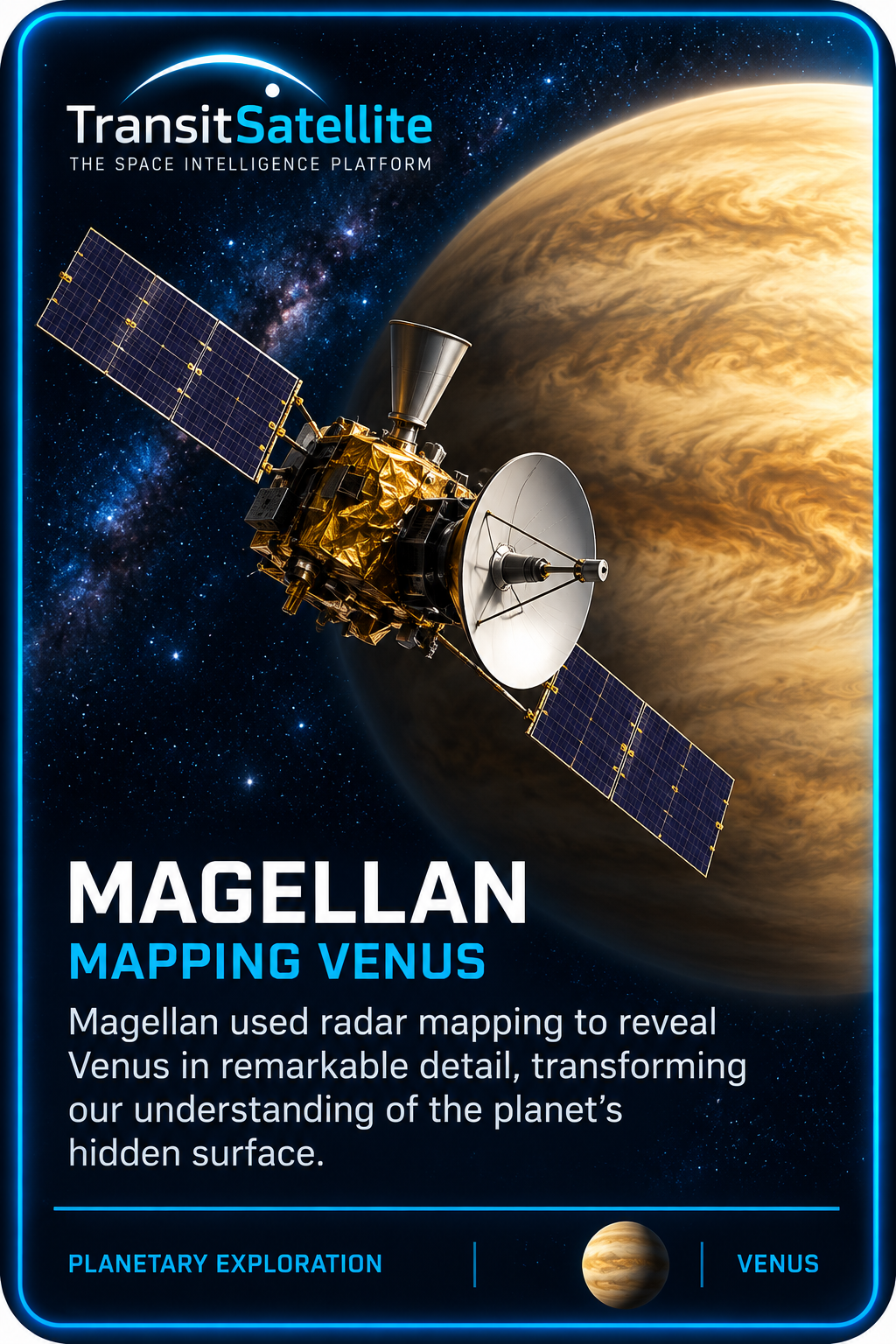
Mission
Learn how Magellan connects Venus, radar imaging, cloud-covered worlds, and planetary mapping from orbit.
Object type
Radar mapping orbiter
Target / region
Venus
Known for
Radar mapping of Venus
TransitSatellite connection
Magellan connects Venus, radar mapping, orbital surveys, and how spacecraft can reveal surfaces hidden from visible light
Why this mission belongs in the Library
Learn how Magellan connects Venus, radar imaging, cloud-covered worlds, and planetary mapping from orbit.
The story
Mapping a hidden world
Magellan is part of the TransitSatellite mission Library because it gives users a concrete example of how spacecraft are designed for a specific target, environment, and science goal.
The mission is known for high-resolution radar mapping of venus, which makes it a strong connecting page between the Solar System map, Library stories, and future education content.
Mission design
Radar as a spacecraft tool
Every mission has a path. For Magellan, the route, timing, instruments, and operating environment all shape what the spacecraft can accomplish.
That makes this story useful for explaining that spaceflight is not only about reaching a destination. It is also about choosing the right orbit, flyby path, landing plan, communication method, or observing location.
Why it matters
A mission that completes the planet story
As a venus orbiter, Magellan helps show how different mission types answer different questions.
Some missions orbit, some land, some fly past, some return samples, and some observe from carefully chosen places in space.
TransitSatellite connection
Venus becomes more than a bright sky object
Magellan connects Venus, radar mapping, orbital surveys, and how spacecraft can reveal surfaces hidden from visible light.
In the TransitSatellite Library, Magellan helps create a connected trail from satellites and planets into mission planning, engineering, science, and the wider space story.
Continue exploring