

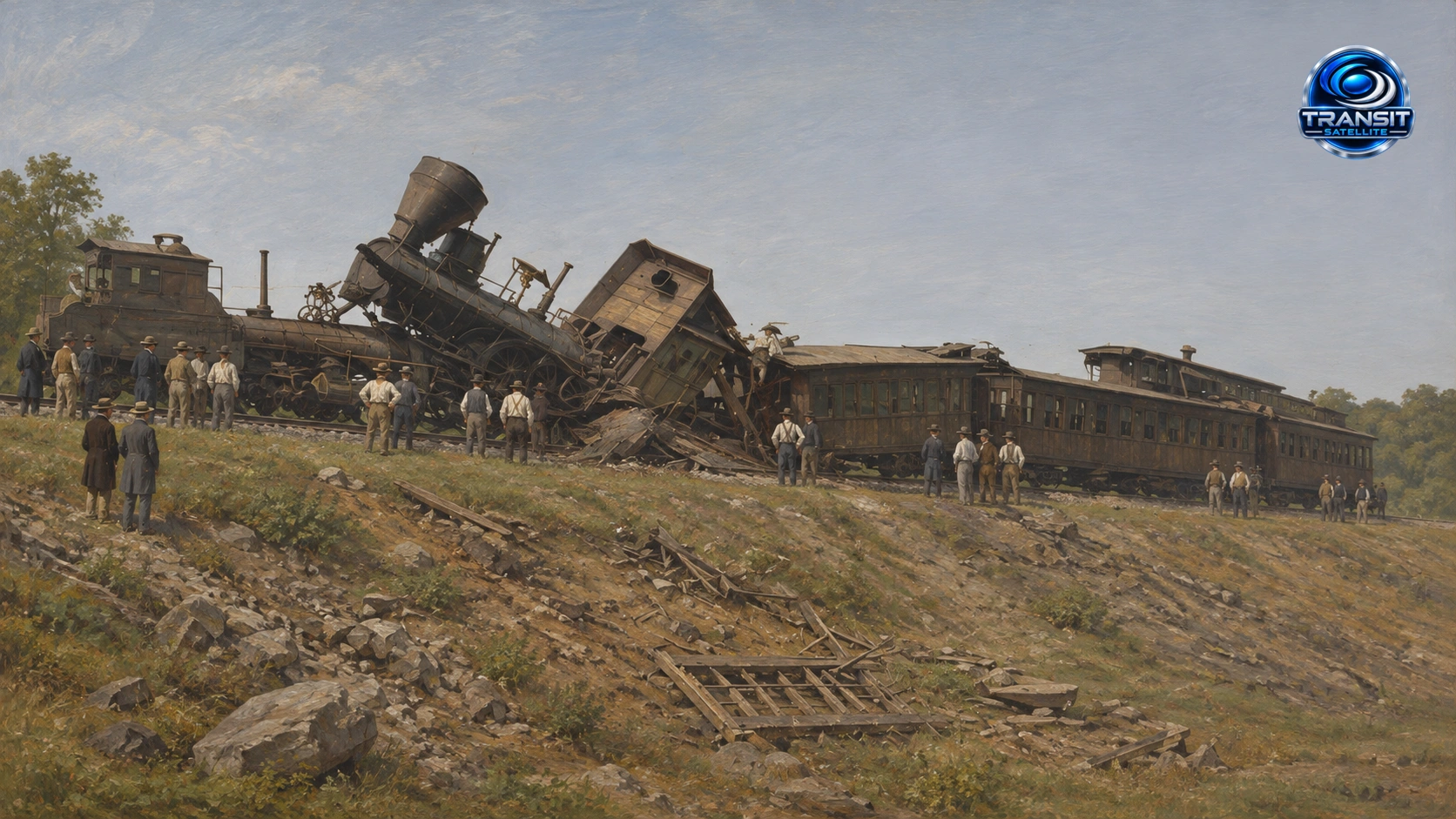
On the morning of August 12, 1853, an excursion train traveled south through Rhode Island on the Providence and Worcester Railroad. Its passengers were heading toward Providence, looking forward to a day away from home. Another passenger train was coming north. Near Valley Falls, the two trains would have to share a stretch of single track, and the timetable was supposed to keep them safely apart.
Frederick W. Putnam, known in later accounts as Fred, was responsible for the excursion train as its conductor. Railroad work required him to follow the schedule, keep track of the train’s progress, and coordinate with its engineer. The Blackstone Valley Historical Society describes him as 25 years old and says he had little experience in the role. If that reported age is right, he was born around 1827 or 1828. Beyond the events surrounding the collision, however, much of his life remains difficult to trace.
At Valley Falls, Putnam had a decision to make. The train needed to reach a switch before the northbound train arrived, or wait until the line was clear. According to the historical society’s account, he checked his watch and asked engineer Ephraim Gates whether they could reach the switch in the time that appeared to remain. Gates believed they could. Their train continued, but the watch was later found to be about two minutes slow.
Those missing minutes mattered. As the trains approached a curve, neither crew had much room to react. They collided head-on, crushing locomotives and passenger cars. The Smithsonian reports that fourteen people died; The Henry Ford’s description of an 1853 engraving gives thirteen. Accounts of the number injured also differ. Whatever the final count, passengers and families suffered an enormous loss, and the wreck became a subject of public grief and scrutiny.
The aftermath was recorded in words and pictures. A contemporary engraving now in The Henry Ford’s collection depicts the collision and the scene around the wreck. Newspapers reported on the dead and injured, while officials began asking why trains carrying so many people had been allowed to approach one another on a single track. Putnam’s watch became an obvious part of that question, but the inquiry also brought attention to the decisions and systems surrounding him.
Later accounts describe criticism of Putnam’s experience and his decision to proceed. They also raise questions about the railroad’s role in assigning him to the train and ensuring that crews had reliable timepieces. The accounts do not agree on every detail of the watch. One later account says it was borrowed and had not been properly checked; another says it had been set to company time the previous evening. Without the original testimony available for comparison, those claims should remain possibilities rather than settled facts.
Public judgment did not end with the first reports. An American Bar Association account says Putnam was charged with manslaughter, but the outcome of that reported charge has not been established in the sources reviewed for this story. Separately, the Smithfield Historical Society cites an 1854 newspaper report about a civil trial that questioned some of the early blame placed on him. A charge, a newspaper accusation, and the outcome of a court case are different things; the surviving record needs to be followed before drawing a conclusion about his later life.
The disaster also exposed the limits of a railroad system that depended heavily on schedules, watches, and decisions made along the line. The Smithsonian notes that, after the wreck and public criticism, some New England railroads strengthened operating rules and ordered more reliable clocks and watches. Timekeeping was one part of safety. Training, signals, communication, track arrangements, and the time allowed between trains mattered too.
Thirty years later, in 1883, North American railroads adopted broad standard time zones. Valley Falls was not caused by a disagreement between those later zones: the accounts connect it to an inaccurate watch and the operation of opposing trains on shared track. The two events are connected by a larger problem. As railroads moved people faster and farther, workers in different places needed dependable ways to agree on the time.
Historical note: This account uses published historical summaries and museum records. The reported age and resulting birth-year estimate are not a verified birth record. No census entry, family, appearance, private thoughts, or later fate has been confidently linked to Putnam. The dialogue above is paraphrased from a later account, not a verbatim transcript. Casualty figures and watch details differ among sources, and the original inquest and court files still warrant review.