
DarkSat
Brightness Testing, Astronomy and Satellite Design
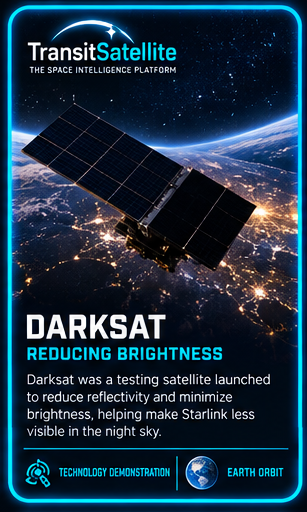
DarkSat is a mission story that lets users explore explore DarkSat and the engineering effort to reduce the visual brightness of large satellite constellations.
Mission
Explore DarkSat and the engineering effort to reduce the visual brightness of large satellite constellations.
Object type
Experimental Starlink satellite
Target / region
Low Earth orbit
Known for
Experimental brightness-reduction treatment
TransitSatellite connection
Satellite visibility, astronomy concerns, and spacecraft surface treatments
Why this mission belongs in the Library
Explore DarkSat and the engineering effort to reduce the visual brightness of large satellite constellations.
The story
Brightness Testing, Astronomy and Satellite Design
DarkSat was used to test a darker surface treatment intended to reduce reflected sunlight and improve understanding of satellite brightness.
This page connects the Starlink tracker to the engineering history behind the spacecraft users see moving across the globe.
Mission design
Built as part of a large low-Earth-orbit network
Starlink is not a single spacecraft mission. It is a constellation architecture in which many satellites, launch campaigns, ground systems, and user terminals operate together.
That makes each generation useful for explaining how satellite design changes as a network scales and its goals expand.
Why it matters
A step in the evolution of satellite internet
This generation or experiment represents a distinct step in the development of Starlink technology.
Following these pages in sequence lets TransitSatellite users see how a modern constellation evolves through prototypes, operational generations, engineering experiments, and new communications capabilities.
TransitSatellite connection
From the history page to the live Starlink tracker
Satellite visibility, astronomy concerns, and spacecraft surface treatments.
In TransitSatellite, this page links the history and engineering story to the live Starlink tracking experience and the people who helped shape satellite communications.
Continue exploring