
Free classroom lesson · Grades 6–8 · 35 minutes
Why do satellites stay in orbit?
Discover how gravity and sideways motion keep spacecraft in orbit around Earth.
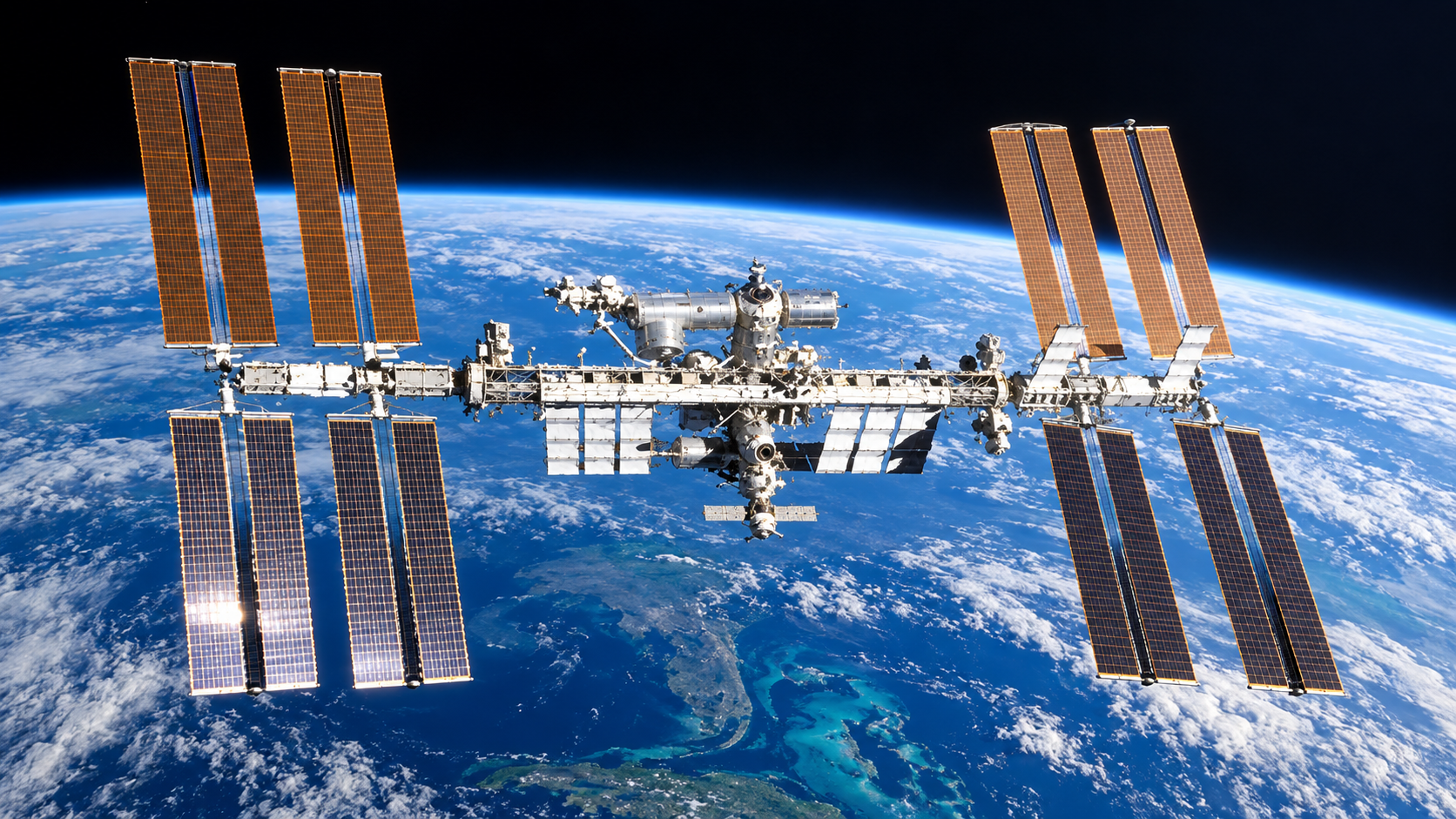
Illustrative spacecraft artwork; not a live telescope or satellite feed.
Learning objectives
- Explain that gravity acts on satellites in orbit.
- Describe the role of sideways speed in an orbit.
- Compare low Earth orbit with higher orbital paths.
Materials
- Paper and pencil
- Optional: TransitSatellite satellite tracker
Essential question
How can a satellite keep falling toward Earth without hitting the ground?
Explore the science
Gravity does not disappear in space. Earth pulls on a satellite, changing the direction of its motion continuously.
A satellite also moves sideways very quickly. As it falls, Earth curves away beneath it. In a stable orbit, the spacecraft keeps falling around Earth rather than directly onto the ground.
Astronauts appear weightless because they and their spacecraft are falling together. Satellites in very low orbit may need occasional boosts because thin atmospheric drag slows them down.
Investigation
- Draw Earth as a circle. Sketch a slowly thrown object falling back to the ground.
- Sketch a much faster object that curves around Earth while falling.
- Open the satellite tracker and locate the International Space Station. Compare its orbital path with another satellite.
- Write two sentences explaining why a spacecraft can orbit without constantly firing its engines.
Discuss and reflect
- Would a satellite keep orbiting if Earth suddenly stopped exerting gravity?
- Why might an orbiting spacecraft need occasional engine boosts?
Self-check · No account required
Check your understanding
Which statement best explains a satellite in a stable Earth orbit?
Responses stay on this page only. No student answers are transmitted or saved.
For educational use. The activity does not save or transmit quiz answers and contains no affiliate marketing.