
Free classroom lesson · Grades 9–12 · 45 minutes
How do space telescopes see invisible light?
Compare Hubble and Webb to discover why astronomers observe beyond visible light.
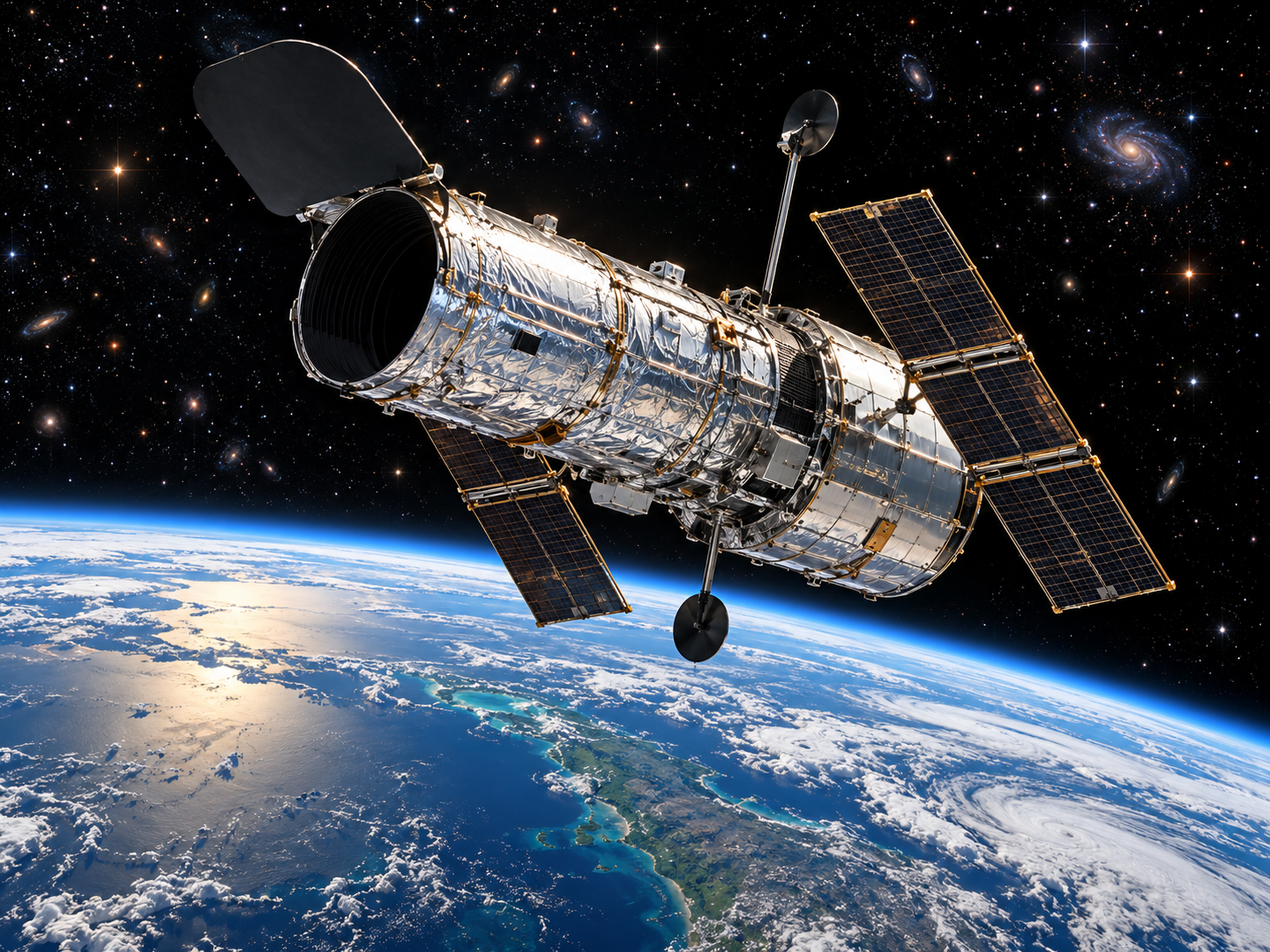
Illustrative spacecraft artwork; not a live telescope or satellite feed.
Learning objectives
- Place visible and infrared light on the electromagnetic spectrum.
- Explain the need for infrared telescope cooling.
- Compare Hubble and Webb’s observational capabilities and locations.
Materials
- Notebook
- Electromagnetic spectrum diagram
- Optional calculator
Essential question
What can telescopes reveal when they detect light our eyes cannot see?
Explore the science
Visible light is a small part of the electromagnetic spectrum. Infrared light has longer wavelengths than visible red light and can reveal cool objects and distant galaxies.
Hubble observes primarily ultraviolet, visible, and near-infrared wavelengths from low Earth orbit. Webb specializes in near- and mid-infrared observations around the Sun–Earth L2 region.
Infrared instruments need protection from heat emitted by the telescope itself. Webb uses a large sunshield and additional cooling to detect faint infrared signals.
Investigation
- Draw the electromagnetic spectrum in order of increasing wavelength.
- Mark visible light, near-infrared, and mid-infrared on your diagram.
- Read the TransitSatellite Webb mission story and Hubble satellite engineering story.
- Explain why Webb’s sunshield is essential for infrared observations.
Discuss and reflect
- How can cosmic redshift make infrared astronomy useful?
- Why do astronomers still use both Hubble and Webb?
Self-check · No account required
Check your understanding
Why does the James Webb Space Telescope use a large sunshield?
Responses stay on this page only. No student answers are transmitted or saved.
For educational use. The activity does not save or transmit quiz answers and contains no affiliate marketing.