spacecraft
Discovery orbiter
Reusable crewed orbiter carrying payloads and astronauts to the station.
TransitSatellite Library / Launch Vehicle Engineering
Reusable crewed spacecraft and launch system
Space Shuttle Discovery delivered the main Kibo Pressurized Module on STS-124 and Leonardo as a permanent station module on STS-133.

Space Shuttle Discovery was a reusable crewed orbiter launched with an external propellant tank and two solid rocket boosters. Its payload bay and robotic systems made it possible to transport and position large International Space Station hardware.
On STS-124 in May 2008, Discovery carried the principal pressurized laboratory element of Japan’s Kibo complex. On STS-133 in February 2011, Discovery delivered Leonardo for installation as the Permanent Multipurpose Module. These missions extended the station’s scientific facilities and long-term logistics capacity.
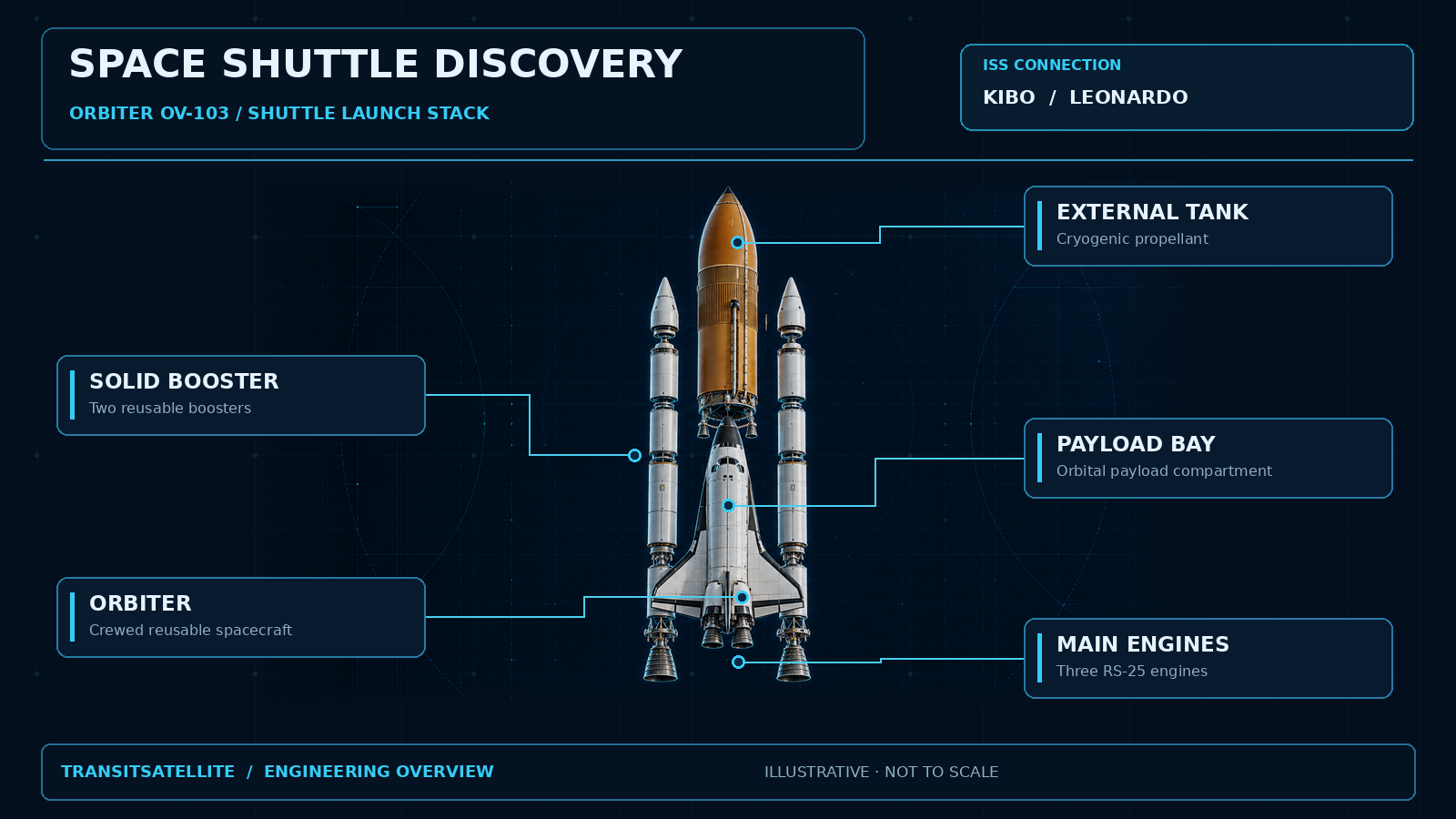
spacecraft
Reusable crewed orbiter carrying payloads and astronauts to the station.
propellant
Fed the orbiter main engines during powered ascent.
propulsion
Two boosters supplied early ascent thrust.
propulsion
Three engines used liquid propellants from the external tank.
cargo
Transported Kibo and Leonardo mission hardware.
robotics
Assisted the movement and installation of ISS hardware.
May 31, 2008
February 24, 2011
TransitSatellite connections