spacecraft
Atlantis orbiter
Reusable crewed spacecraft with flight deck, payload bay, and orbital maneuvering systems.
TransitSatellite Library / Launch Vehicle Engineering
Reusable crewed spacecraft and launch system
Space Shuttle Atlantis delivered the Destiny U.S. laboratory on STS-98 and the Columbus European laboratory on STS-122, expanding ISS research capability.

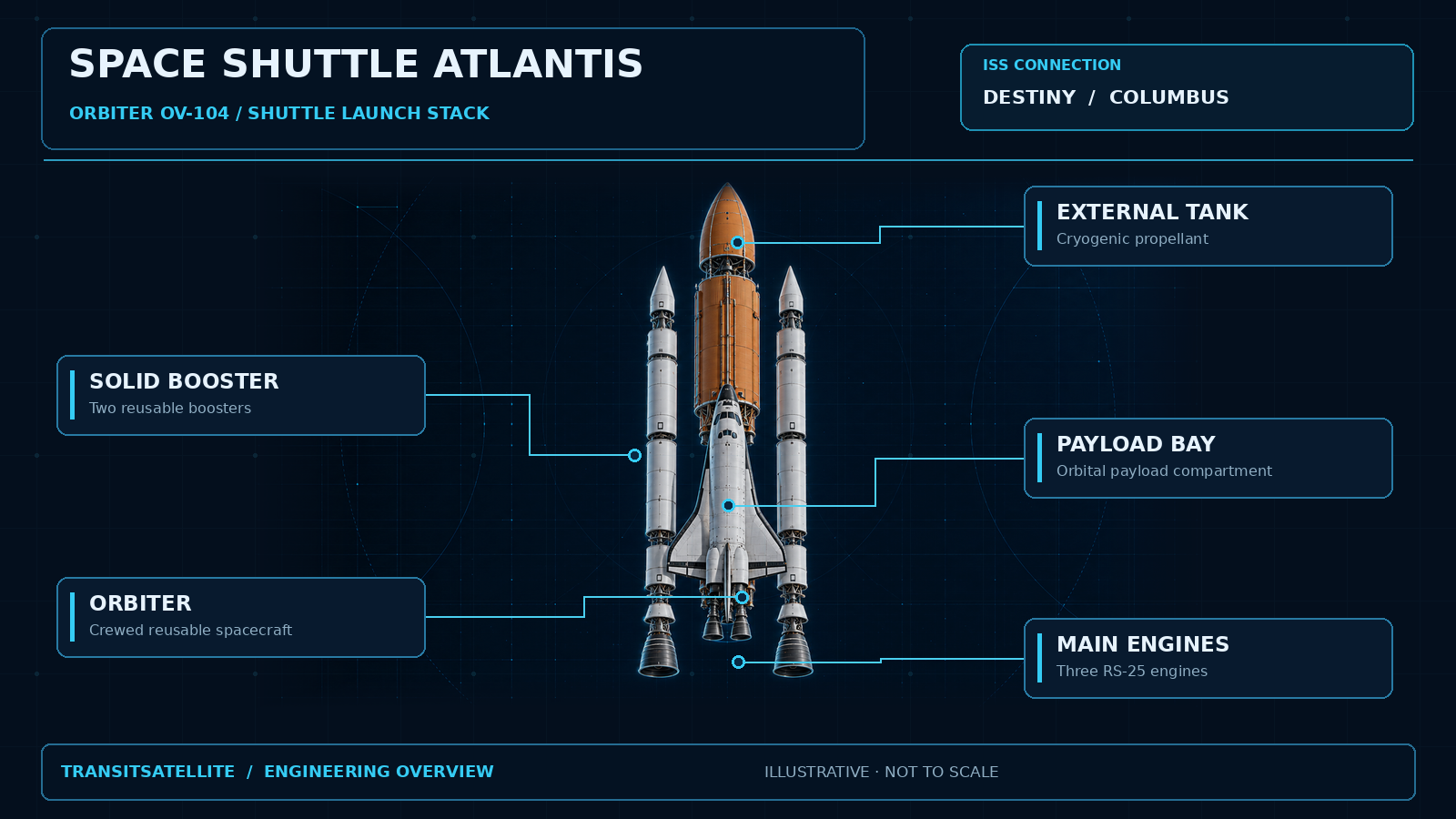
Space Shuttle Atlantis combined a reusable crewed orbiter with an external propellant tank and two reusable solid rocket boosters for ascent. The orbiter carried astronauts, docking systems, a robotic arm, and a large payload bay that could transport pressurized station modules.
During STS-98 in February 2001, Atlantis delivered the Destiny laboratory. During STS-122 in February 2008, it delivered the Columbus laboratory. Both missions used the Shuttle cargo bay and station assembly operations to add permanent research facilities to the ISS.
spacecraft
Reusable crewed spacecraft with flight deck, payload bay, and orbital maneuvering systems.
propellant
Supplied propellants to the orbiter main engines during ascent.
propulsion
Two boosters provided major thrust during the first portion of ascent.
propulsion
Three liquid-propellant engines powered ascent using external-tank propellants.
cargo
Transported ISS laboratory modules and related mission hardware.
robotics
Supported handling and positioning of payloads during station assembly.
February 7, 2001
February 7, 2008
TransitSatellite connections