propulsion
First stage
Initial ascent using clustered liquid-propellant rocket engines.
TransitSatellite Library / Launch Vehicle Engineering
Heavy-lift launch vehicle
The three-stage Proton-K launch vehicle placed the Zarya and Zvezda modules into orbit, establishing essential elements of the International Space Station.

Proton-K was a three-stage, expendable launch vehicle used for heavy payloads from Baikonur Cosmodrome. Its first, second, and third stages accelerated station modules toward low Earth orbit before separating from the payload. The rocket provided launch energy; the modules carried the systems required for their own orbital operations.
Proton-K launched Zarya on November 20, 1998, the first element of the International Space Station. It later launched the Zvezda service module on July 12, 2000. These two missions delivered foundational Russian-segment capabilities for early assembly, station control, and long-duration habitation.
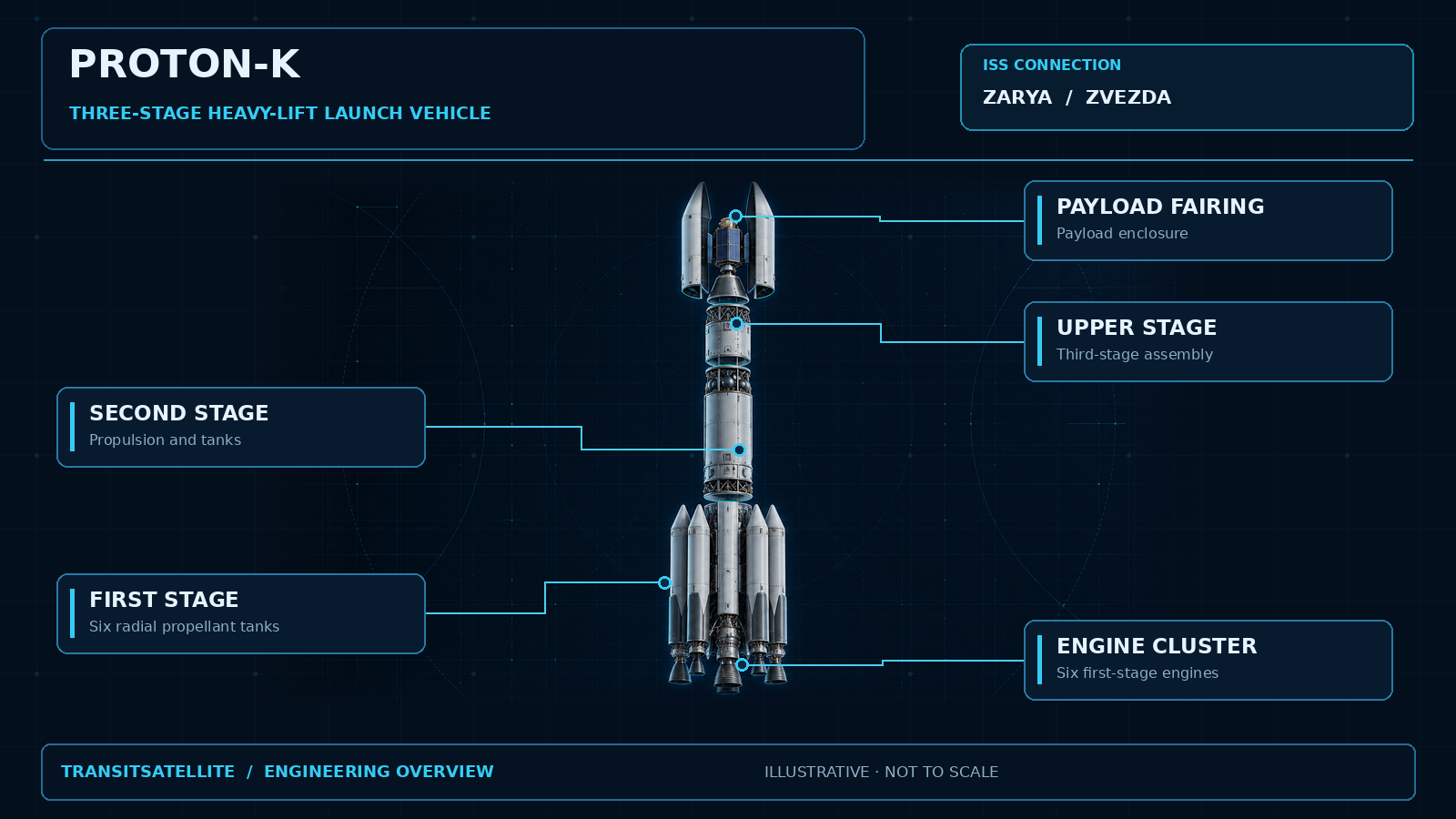
propulsion
Initial ascent using clustered liquid-propellant rocket engines.
propulsion
Continues ascent after first-stage separation.
propulsion
Completes the main orbital-insertion portion of the launch sequence.
structure
Protects the station module during ascent through the atmosphere.
structure
Secures the module to the launch vehicle until separation.
November 20, 1998
July 12, 2000
TransitSatellite connections